How to Study a Top Etsy Shop's Listings and Pricing With AgentKey
Connect Etsy to your AI agent with AgentKey, pull every listing of the leading shops in your niche, and turn them into price ladders and product lines. Steps, tools, prices and the prompt.
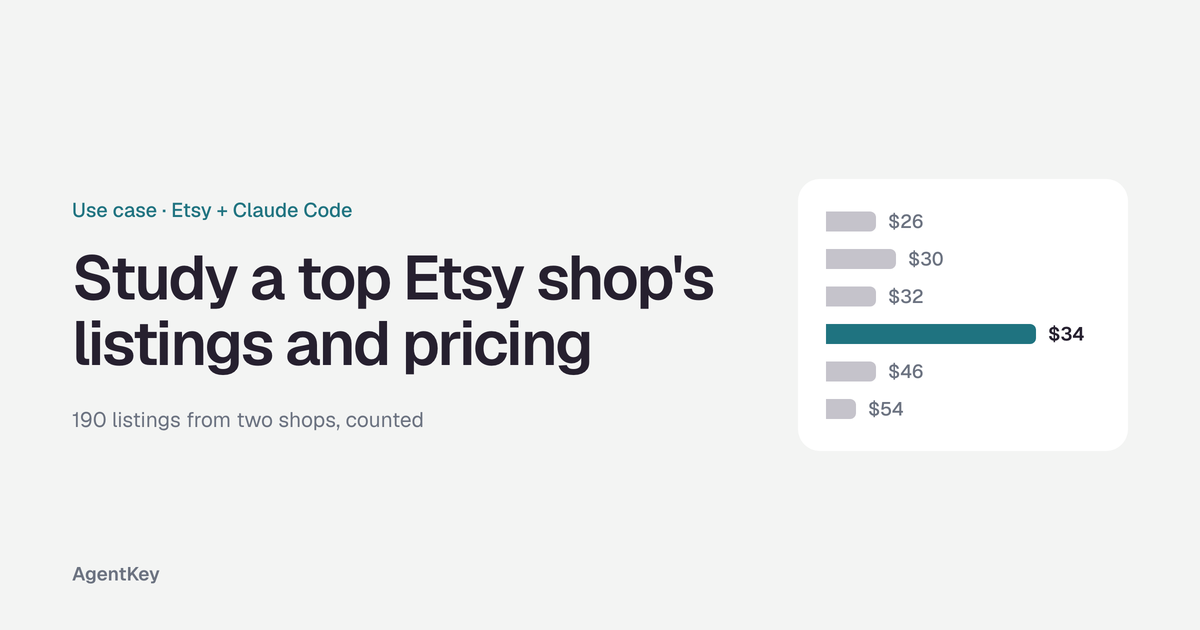
Pull every listing of the leading shops in your Etsy niche and turn them into a price ladder and a list of product lines. Connect AgentKey, then paste this into your agent:
Use AgentKey's Etsy tools to study the leading shops for this Etsy search phrase: [PHRASE]. Use only AnyAPI/etsy_search, AnyAPI/etsy_shop, AnyAPI/etsy_shop_listings and AnyAPI/etsy_product. Read each tool's price before any paid call. After every call add up credits_charged, and stop and ask me if the total passes 4.8 credits or one call is charged more than 0.4. Retry a timeout up to three times. Pass only the parameters named here, plus jq to trim responses; jq runs on the tool's output, so rows are at .data.items. Do not use requireFields or sort.

1. Call AnyAPI/etsy_search with query set to the phrase, for page 1 and then page 2. Drop rows where isSponsored is true. Rank the remaining shops yourself by reviewsCount, which is the shop's review count, not the listing's. A listing can appear on both pages, so count each shop once. Report rows returned, sponsored rows and the ranked list.

2. For the top two shops, call AnyAPI/etsy_shop with shopName, and report listingCount, salesCount and reviewsCount. Call them Shop A and Shop B.

3. For each shop, call AnyAPI/etsy_shop_listings with shopName and page, starting at page 1, until you have every listing or have pulled 4 pages. Keep listingId, title, price, originalPrice and currency. Remove repeated listingIds, keeping the copy that has an originalPrice; page 1 can repeat later listings. Report unique listings against listingCount.

4. For each shop report: the cheapest, median and most expensive price; how many listings sit at each price or price band; how many have an originalPrice and how large the markdown is; the product lines you sorted the titles into, with a count and price range for each; and how the titles are built (length, repeated words, sale or made-to-order labels).

5. For each shop, call AnyAPI/etsy_product once, with listingId set to that shop's highest-placed unsponsored listing from the search results, and compare the listing's own reviewsCount with the shop's.

Do not name shop owners. Separate what the data shows from what you infer, and list what the tools did not return (badges, tags, shipping cost).
Before you list a new product on Etsy, you want to know what the shops ahead of you sell and what they charge. The usual way is to open a shop, scroll, and copy prices into a spreadsheet, which rarely gets done for a shop with 147 listings.
An AI agent can do the copying and the counting, with one catch: in our test, Etsy refused every search, shop and listing page the agent asked for. This guide shows how AgentKey supplies the listings. We ran every step on November 24, 2026, for the search phrase "handmade ceramic mug", and the numbers below come from that run.
Etsy shops are often one person, so we call the two shops Shop A and Shop B and name nobody.
AgentKey covers one part of the job. It returns search results, shop figures and listings; your agent's model sorts and counts them, and you check the result. The tools returned no badges, tags or shipping costs.
At the end you will have:
- A ranked list of candidate shops.
- Each shop's price ladder, with the listings at each price.
- Each shop's product lines, with counts and price ranges.
- A record of the sample, the gaps and the cost.
Why can't an AI agent read an Etsy shop's listings on its own?
In our test, Etsy refused the agent's page fetch, and the two routes that did work returned 7 to 11 listings per shop. A price ladder needs every listing in the shop, each with its price.
We asked Claude Code to get that with its built-in tools first. It requested five etsy.com pages: a search page, a market page, a shop page, the same shop page with sort parameters, and a listing page. Each request came back as HTTP 403 Forbidden.
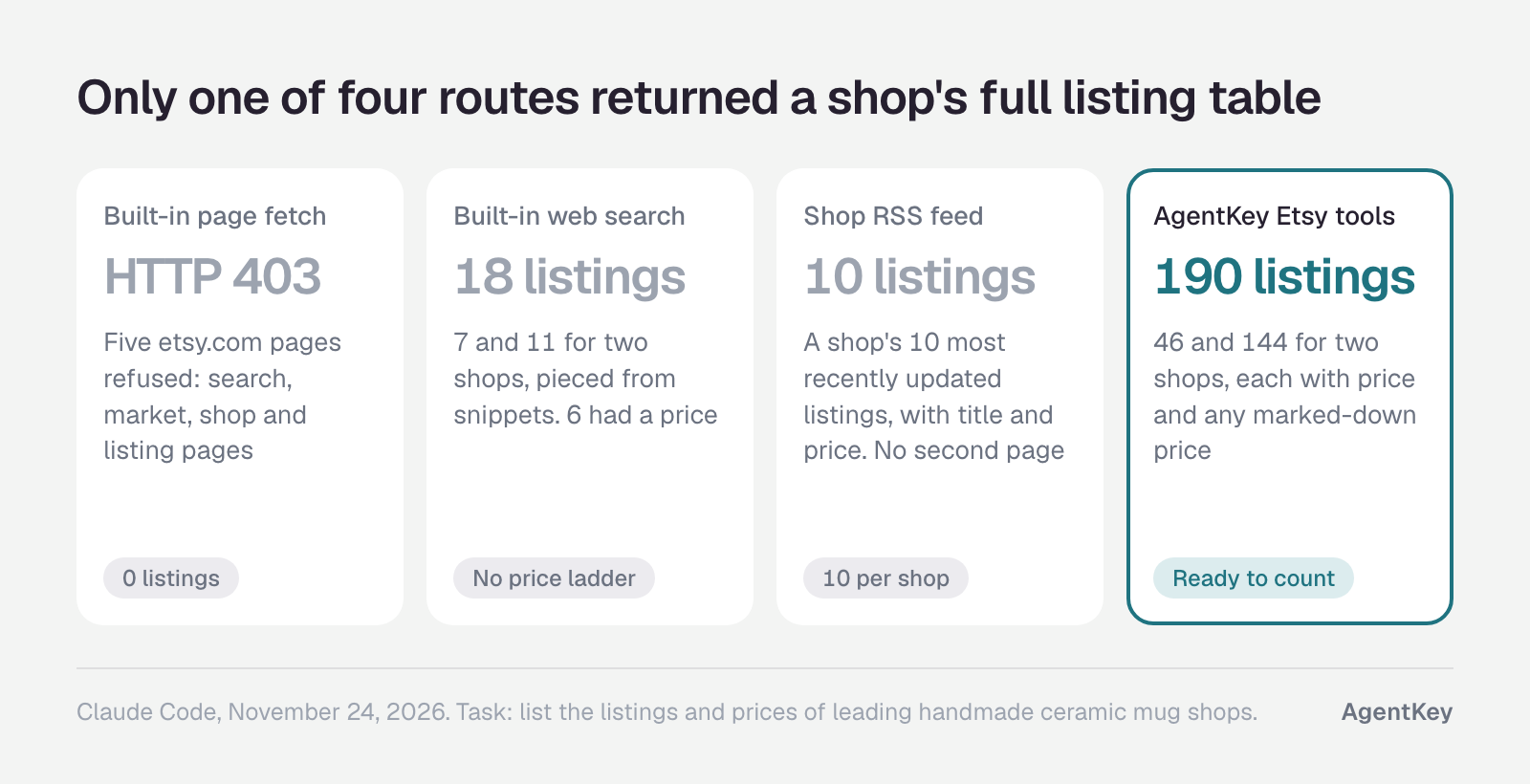
Two routes got part of the way. Etsy publishes an RSS feed for each shop, and the agent could read it: 10 listings per shop, the most recently updated ones, each with a title and a price. Asking for a second page returned the same ten.
Web search reached Etsy too. A separate agent with no context, given the whole task and 20 calls, pieced together 18 listings for two shops from search snippets: 7 for one and 11 for the other. Six of the 18 had a price it could tie to a title.
Ten recent listings show what a shop touched last, and they are not a ladder. The other route is Etsy's own Open API, which needs a developer key and which we did not test.
Which AgentKey tools does this use?
Four Etsy tools do the reading, and finding them is free. Prices and capabilities were verified on November 24, 2026. All four are metered, so the listed price is a minimum; every call in our run was charged that minimum.
1. Etsy Search
Searches Etsy listings by keyword. In the AgentKey catalog it is named AnyAPI/etsy_search.
Pricing: from 0.2 credits per page. In our run each page was charged 0.2.
Features: a query and a page number, which this run used, and also a sort order and a price range. Each row has a title, price, original price, shop name, the shop's rating and review count, and a sponsored flag. Our pages held 12 rows each.
2. Etsy Shop
Looks up one shop by name. Its catalog name is AnyAPI/etsy_shop.
Pricing: from 0.2 credits per call. Each of our two calls was charged 0.2.
Features: returns the shop's listing count, sales count, review count and rating. The follower count came back empty for both shops.
3. Etsy Shop Listings
Lists a shop's active listings, a page at a time. Its catalog name is AnyAPI/etsy_shop_listings.
Pricing: from 0.2 credits per page. Each of our six pages was charged 0.2.
Features: takes a shop name and a page number; returns each listing's ID, title, price, original price and currency. A page held 36 listings, and one first page held 40 because it repeated four from later pages. It returned no badges, tags or review counts.
4. Etsy Product
Looks up one listing by its ID. Its catalog name is AnyAPI/etsy_product.
Pricing: from 0.2 credits per call. Each of our two calls was charged 0.2.
Features: returns the listing's own review count and rating, its category, stock, ship-from country and variations. The catalog also describes favorites and materials; both came back empty on our two listings.
5. Tool discovery and price check
Your agent finds a tool, reads its parameters and sees its price before it spends anything.
Pricing: free.
Features: search the catalog in plain language; see each tool's parameters and per-call cost; check remaining credits.
The 12 calls in the steps below cost 2.4 credits in total in our run. On the Lite plan, which is $12.90 a month for 500 credits, that is about 6 cents.
How to study a top Etsy shop, step by step
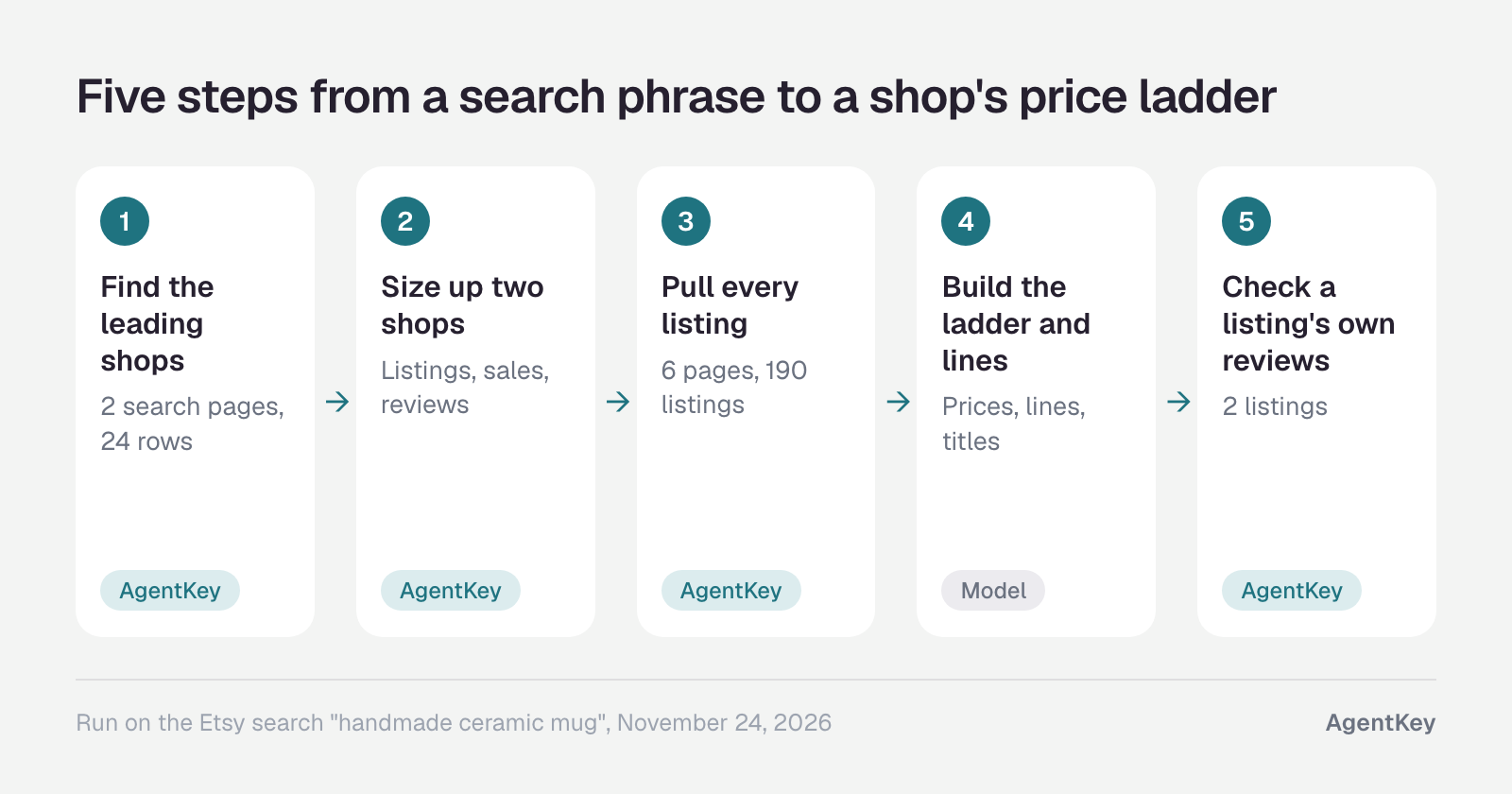
Connect AgentKey once, then run five steps: find the shops, size them up, pull their listings, build the ladder and the lines, and check one listing's own reviews.
Before you start
Install AgentKey with the one-line installer. It finds the agents on your machine, adds AgentKey to each, and opens a browser tab to sign in. A new account starts on the Free plan with no card.
curl -fsSL https://agentkey.app/install.sh | bashOther install methods, including the Claude Code plugin, are in the installation guide. The Etsy for Claude Code page shows what the connection gives you.
Then fix the search phrase and the sample before you look at any data. We chose two pages of search results and at most four pages of listings per shop.
Step 1. Find the leading shops in your niche
Ask for two pages of search results and rank the shops yourself, from the counts the tool returns.
Your agent calls Etsy Search with the phrase, for pages 1 and 2. Two calls cost 0.4 credits and returned 24 rows, 10 of them sponsored. One sponsored listing appeared on both pages, so the rows held 23 listings from 23 shops.
Rank the 14 unsponsored rows by review count. The top two showed 797 and 722 reviews, and the bottom two showed 12 and 11. Fourteen rows is a thin basis for "leading", so read the result as two established shops that rank for the phrase.
The rows change between runs. A second agent ran the same search later that day and got a different set: the same two shops led, and third place went from a shop with 519 reviews to one with 691.
Step 2. Size up the two shops
One Etsy Shop call per shop tells you how big each is. Two calls cost 0.4 credits.
Shop A had 46 listings, 2,925 sales and 797 reviews. Shop B had 147 listings, 2,707 sales and 722 reviews. The review counts matched the search rows, which shows that the number on a search row belongs to the shop.
The two shops have similar sales, and one has three times the listings.
Step 3. Pull every listing
Your agent calls Etsy Shop Listings page by page. Shop A took two pages and Shop B four, so six calls cost 1.2 credits and returned 190 listings.
That is all 46 of Shop A's listings and 144 of Shop B's 147. We stopped at four pages per shop, which left Shop B's last three.
Remove repeats before you count. Shop B's first page ended with four listings that came back again on pages 2 and 3, so its 148 rows were 144 listings.
Step 4. Build the price ladder and the product lines
This step is the model's work. Shop A has 6 price points across 46 listings, from $26 to $54, and 21 of the 46 sit at $34, the median.
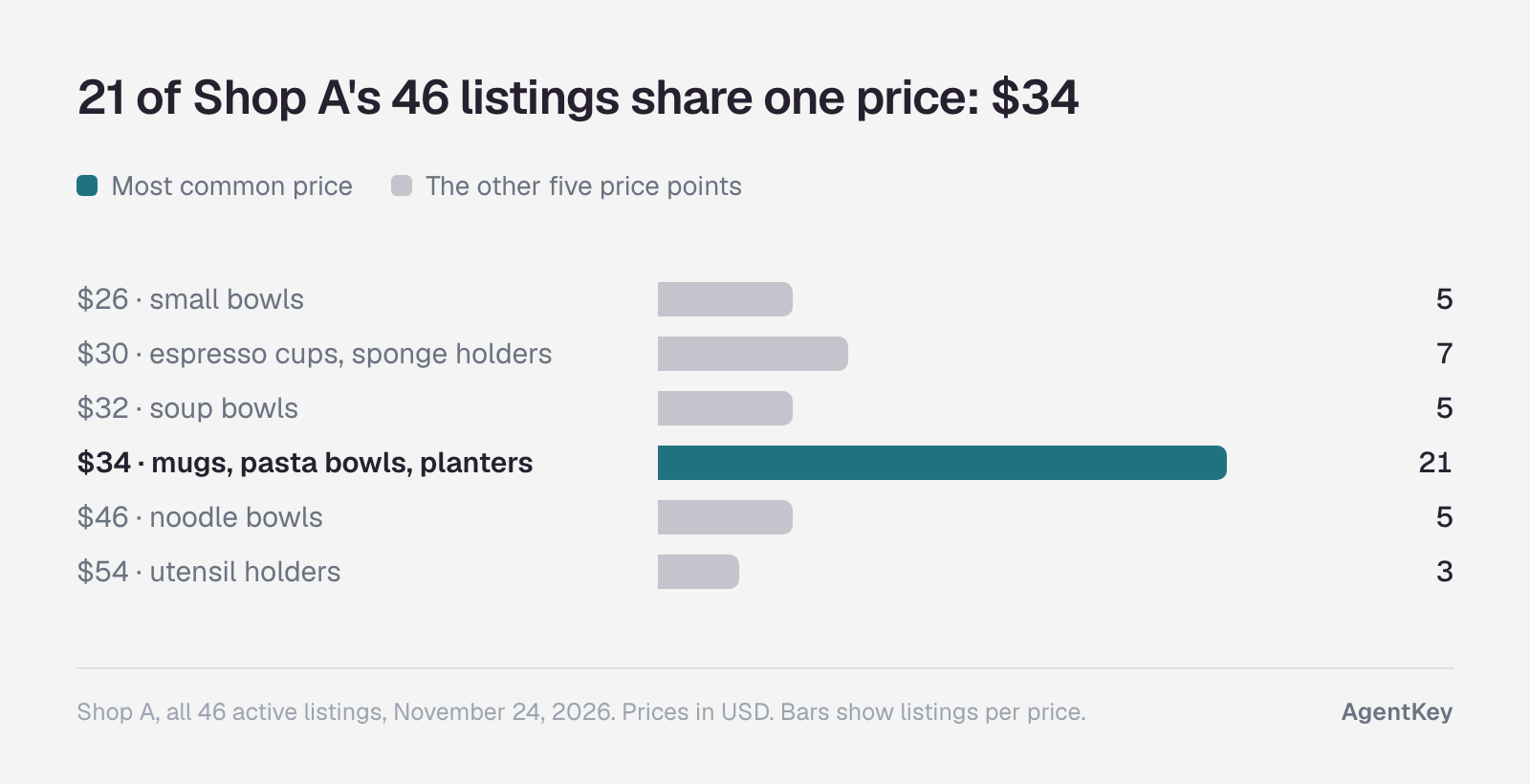
Each product form has one price: all 15 mugs are $34, whatever the shape or glaze. The shop sells nine forms in two to five colourways each, and no listing carried a marked-down price.
Shop B is built differently. Its 144 listings use 57 prices from $12 to $750, with a median of $43.50, and 44 of the 144 cost $100 or more.
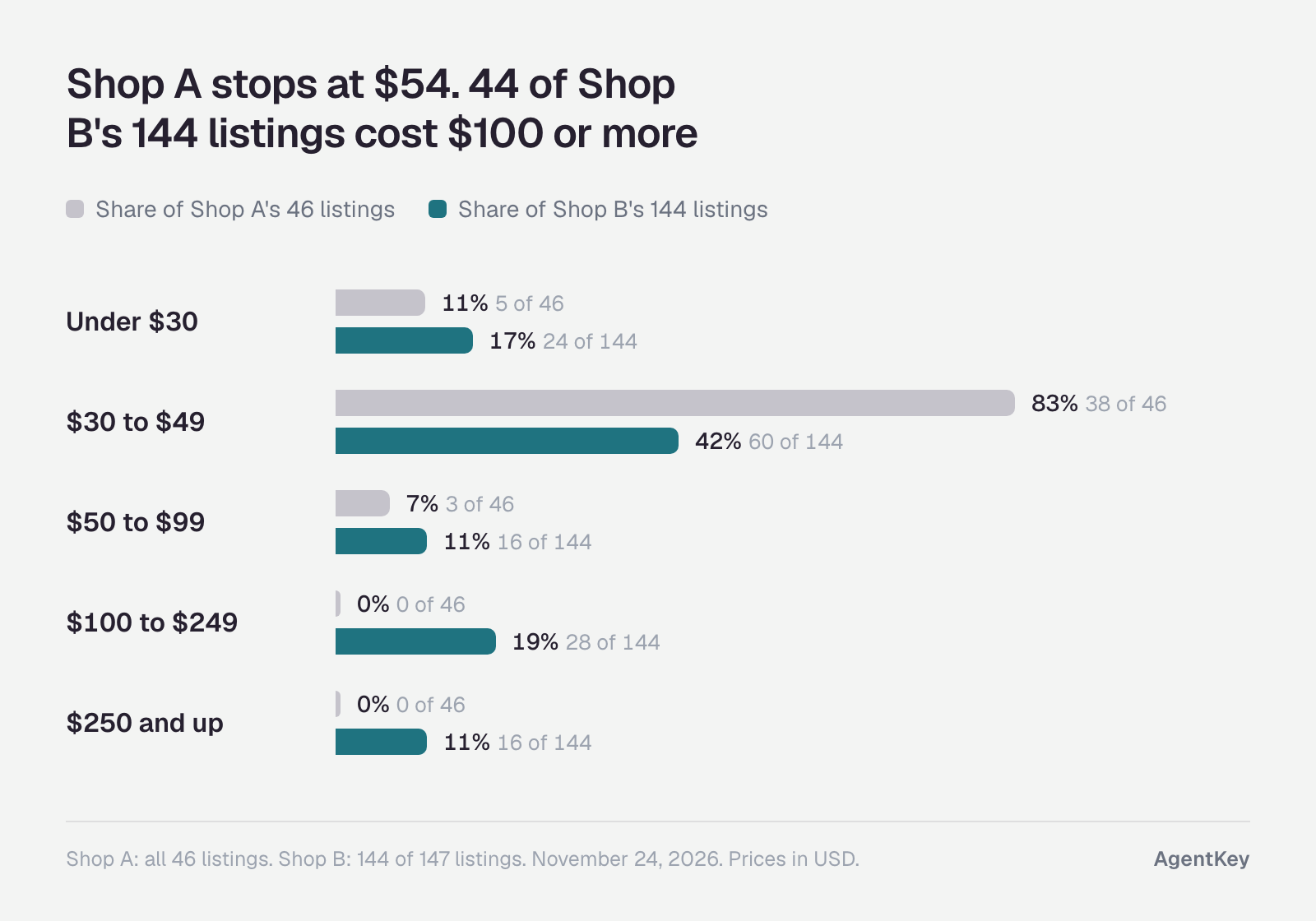
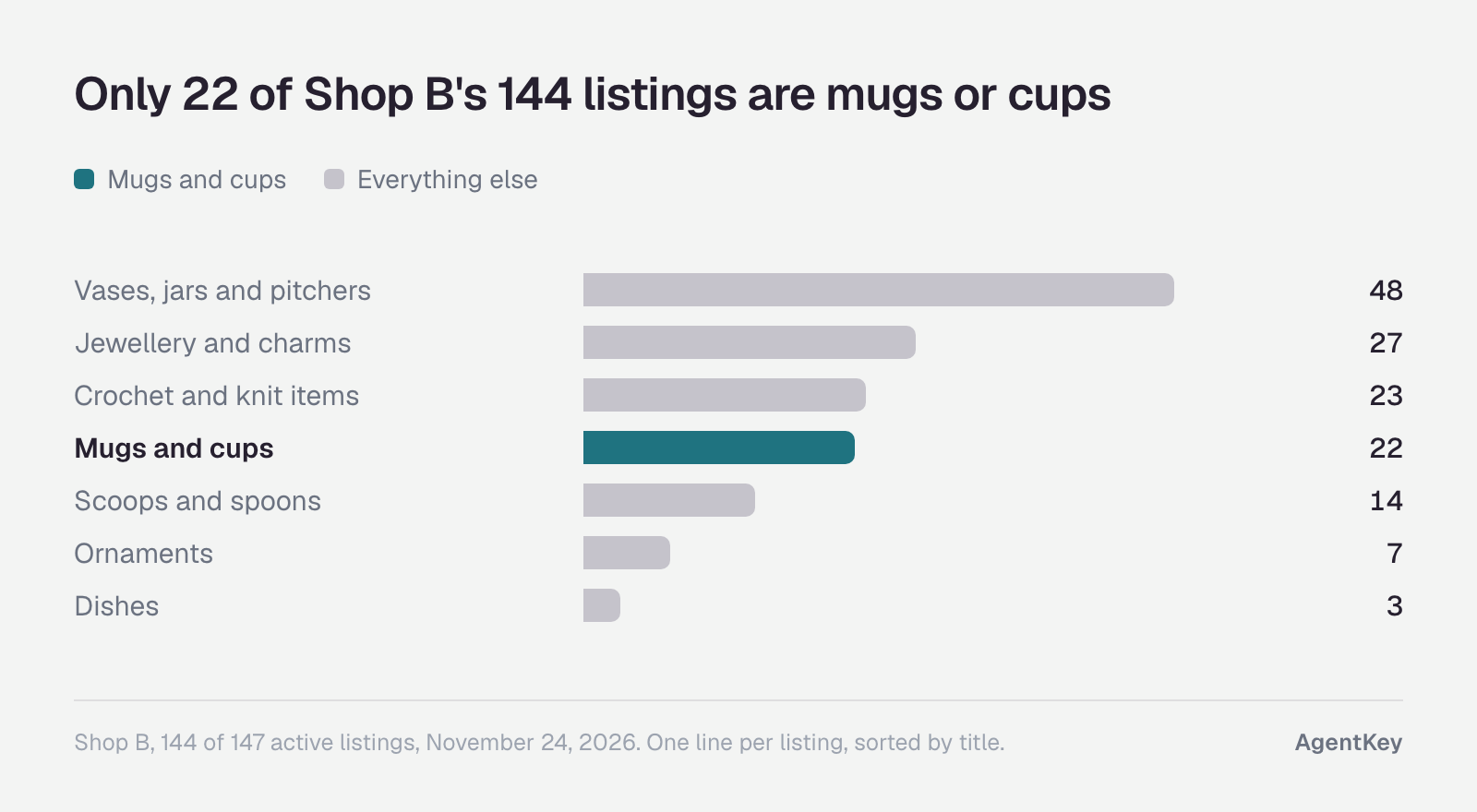
Sorting Shop B's titles into lines shows why. Only 22 of its 144 listings are mugs or cups, priced $26 to $58. The largest line is vases, jars and pitchers: 48 listings with a median of $153.50.
Titles differ too. Shop A's run to a median of six words, a glaze colour plus the form, and 4 of 46 use the word handmade. Shop B's median is nine words; 13 carry a seconds or sample sale label, and eight vases are marked down by 20%.
Our reading, which the data does not prove: Shop A sells a small grid at fixed prices, and Shop B uses mugs as its low-priced entry to a much wider range.
Step 5. Check one listing's own reviews
The listing tool returns no demand signal, so look up the listings that matter one at a time. We checked the listing that put each shop in the search results; two Etsy Product calls cost 0.4 credits.
Shop A's mug had 53 reviews of its own, against the 797 on its search row. Shop B's had 3 against 722; it was a seconds listing with one piece in stock.
At 0.2 credits per listing, checking all of Shop A would cost 9.2 credits. Pick one listing from each price point or line.
How do you check the results?
Recount the listings against the shop's own number, then open a few on Etsy.
- Count unique listings. Compare unique listing IDs with the shop's listing count. Ours were 46 of 46 and 144 of 147.
- Read search review counts as shop totals. A row showing 797 reviews was a listing with 53.
- Expect a different search sample. A second agent ran the printed prompt the same day. Its 14 unsponsored rows held other shops below the top two; the two leading shops and every count for Shop A matched ours.
- Expect small differences in the lines. That agent also counted 22 mugs and cups in Shop B, and split vases, jars, pitchers and dishes differently.
- Check marked-down prices. One Shop B listing came back without an original price on page 1 and with one on page 2.
- Open ten listings in one line. The lines were sorted from titles in a single model pass, without looking at photos.
- Mind the date. This is a snapshot from one day in late November.
- Mind what is missing. No bestseller or popular now badges, no tags, no shipping cost and no personalisation field came back.
When should you use something else?
Use a different route when ten recent listings are enough, or when you need fields these tools do not return.
If you only want to see what a shop listed or renewed lately, read its public RSS feed at etsy.com/shop/ followed by the shop name and /rss. In our test, Claude Code's built-in fetch read it without AgentKey: 10 listings with titles and prices.
If you need tags, shipping profiles or sales per listing, look at Etsy's Open API or a seller research product built for Etsy. We did not test either.
This is the AgentKey blog, and AgentKey provides the tools described here. They return listings and shop figures. They do not judge a price, pick a product for you or tell you what sold last month.
Which tool should you use for each job?
Pick the call from the question you are asking. Prices were verified on November 24, 2026.
- Find shops that rank for a phrase: Etsy Search. 0.2 credits per page of 12 rows in our run.
- See how big a shop is: Etsy Shop. 0.2 credits per shop in our run.
- Get every listing and price in a shop: Etsy Shop Listings. 0.2 credits per page of 36 listings in our run.
- See one listing's own reviews and stock: Etsy Product. 0.2 credits per listing in our run.
- Check a price before spending: tool discovery and inspection. Free.
Conclusion
You now have a way to turn a search phrase into two shops' price ladders and product lines. Run it on your own niche, and open the listings behind a number before you price against it.
Connect Etsy to your agent through AgentKey →
FAQ
Can Claude Code read an Etsy shop without AgentKey?
Only a small part, in our test. On November 24, 2026, its page fetch got HTTP 403 on five etsy.com pages, and the shop's RSS feed gave 10 recent listings with titles and prices. Other agents may have different built-in access.
Do I need to write code?
No. You install AgentKey with one command and then ask your agent in plain language.
How much does a two-shop study cost?
Our run cost 2.4 credits for 12 calls, about 6 cents on the Lite plan. A bigger shop costs more: each page of 36 listings was one call at 0.2 credits.
Does it show bestseller badges, tags or shipping costs?
Not in our run. The listing tool returned titles, prices, original prices and IDs. The product tool added a listing's own review count, stock and ship-from country.
Does AgentKey sort the listings into product lines?
No. AgentKey returns the listings, and your agent's model does the sorting and the counting.
Which agents can run this?
AgentKey lists setup steps for clients such as Cursor, Codex and ChatGPT on its supported agents page. We tested Claude Code only.
Is there a free way to try it?
A new account starts on the Free plan, which includes complimentary credits and needs no card. Finding and inspecting tools does not use credits, so you can check a tool's price before any paid call.