How to Compare a Product's Price and Reviews Across Walmart, Target and Best Buy With AgentKey
Compare one product's price, rating and low-star reviews at Walmart, Target and Best Buy with your AI agent and AgentKey. Steps, tools, prices and the prompt.
See what one product costs at three US retailers right now, how each one rates it, and whether the unhappy buyers at each say the same thing. Connect AgentKey, then paste this into your agent:
Compare one product's listing and low-star reviews at Walmart, Target and Best Buy with AgentKey. Product pages: [WALMART-URL], [TARGET-URL], [BEST-BUY-URL].

Rules: use only the tools and parameters named here, and never requireFields. Read each tool's price with describe_tool before its first paid call. After every call add up credits_charged; stop and ask me if the total passes 4.4 credits or one call is charged more than 0.4. The plan is 11 paid calls at 0.2 each. Retry a timeout up to three times.

1. Listings. Call AnyAPI/walmart_product and AnyAPI/bestbuy_product with the url only. Read the Target product page with your built-in web fetch, because AnyAPI/target_product returned no price in our run; if the fetch fails, say so and go on. For each retailer report price, list price or sale label, stock or seller signal, average rating, rating count and the time you read it, from your own clock. Say whether the UPCs match and which fields were missing.

2. Reviews. Walmart: AnyAPI/walmart_reviews, sort rating_low, pages 1 and 2. Best Buy: AnyAPI/bestbuy_reviews, sort rating_low, pages 1 and 2. Target: AnyAPI/target_reviews with no sort, pages 1 to 5, because rating_low was ignored there in our run; keep ratings 1 and 2. On every reviews call pass this jq: .data | {top: del(.items), items: [.items[] | {reviewId, rating, createdUtc, title, text}]}

3. Check and report: reviews per page against 10; duplicates by reviewId, counted once; whether every Walmart and Best Buy review is rated 1 or 2; the dates covered per retailer and whether they run newest first; any star distribution in top.

4. Give each low-star review one complaint theme, the same themes for every retailer. A review that says this unit broke, stopped working, shut off mid-brew or was replaced for a fault goes under stopped working, whatever else it mentions. Keep order, delivery, seller and support complaints as their own theme. Report counts per theme per retailer, the themes that differ, and up to two paraphrased examples per theme. No reviewer names. Separate data from inference, and say the three samples were drawn differently.
A channel manager at a consumer brand sells one product through several retailers, and each retailer runs its own price, its own promotion and its own review page. In a promotion week the three listings can show three different prices, and the complaints under each can be about the product or about that retailer's delivery.
By hand that means three tabs and a lot of scrolling. An AI agent can do the reading, but in our test it could open only one of the three sites alone.
This guide shows how to get the listings and low-star reviews from all three and count what the reviews complain about. We ran every step on November 24, 2026, in Black Friday week, on one single-serve coffee maker that we call Product A.
AgentKey supplies the listings and reviews your agent cannot reach. The model sorts the complaints, and you check its work.
At the end you will have:
- One row per retailer: price, list price where shown, stock signal, rating and rating count, with the time of the reading.
- A count of low-star complaint themes for each retailer.
- A note of where the three samples differ, so nobody over-reads them.
- A record of what it cost.
Why can't an AI agent compare three retailers on its own?
In our test it could read one retailer out of three. We gave Claude Code's built-in page fetch and web search the task on November 24, 2026.
Walmart answered four page requests, a search page, two product pages and a reviews page, with a robot check. Best Buy's search address led to a country-selection page, and three requests for its product and reviews pages timed out after 60 seconds.
Target was different. Its product page returned the price, the list price, an in-stock label, the rating and the 20 newest reviews, 6 of them rated one or two stars. A sort parameter we guessed for the reviews changed nothing.
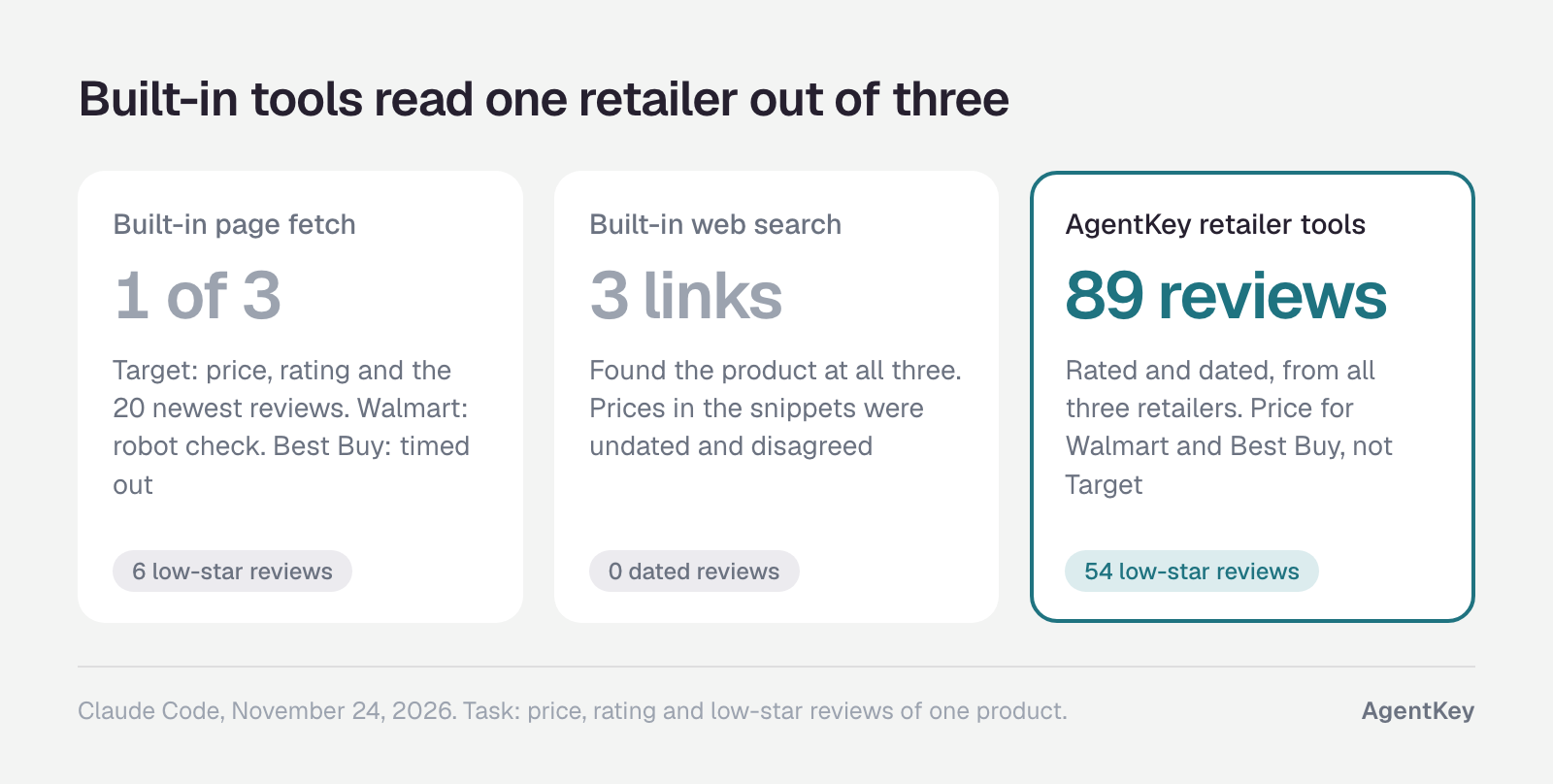
Web search found the product at all three retailers, and we used 3 links, one per site. Across our searches the snippets quoted four different Walmart prices, from $99.99 to $139.00, with no dates.
A second agent with no context got the whole task and 20 calls. It came back with one live listing, Target's, and 6 of the 60 low-star reviews we asked for. AgentKey's tools returned 89 reviews, 54 of them low-star.
So the Target listing does not need AgentKey. The Walmart and Best Buy listings do, and so does any review sample larger than Target's newest 20.
Which AgentKey tools does this use?
Five retailer tools in two groups, plus free discovery. Prices and capabilities were verified on November 24, 2026.
1. Walmart Product and Best Buy Product
Each returns one listing from its product page URL. In the AgentKey catalog they are named AnyAPI/walmart_product and AnyAPI/bestbuy_product.
Pricing: from 0.2 credits per call. The catalog marks both as metered, so the listed price is a minimum. In our run each call was charged 0.2.
Features: we passed the URL and nothing else. Walmart came back with price, availability, seller, rating, review count and UPC. Best Buy came back with price, rating, review count, seller type and UPC, with an empty list price and no stock field.
2. Walmart Reviews, Best Buy Reviews and Target Reviews
Each returns one page of 10 reviews for a product URL. Their catalog names are AnyAPI/walmart_reviews, AnyAPI/bestbuy_reviews and AnyAPI/target_reviews.
Pricing: from 0.2 credits per page, metered. In our run all nine pages were charged 0.2 each.
Features: a page number and a sort order, of which we used rating_low and the default, newest first. Each review has an ID, star rating, date, title and text; Best Buy and Target add a verified-purchase flag and the product's star distribution. The catalog also lists a lowest-rated sort for Target; in our run two Target calls with it came back newest first.
3. Tool discovery and price check
Your agent searches the catalog and reads a tool's parameters and price before it spends anything.
Pricing: free. These calls returned no charge in our run.
Features: plain-language search, a browsable list per retailer, and each tool's parameters and per-call price.
The 11 calls in the steps below cost 2.2 credits in our run and returned 2 listings and 90 reviews, 89 of them distinct. We also called the Target Product tool once, for 0.2. It returned the rating and counts with an empty price, list price and availability, so the steps read Target's page directly.
How to compare the three retailers, step by step
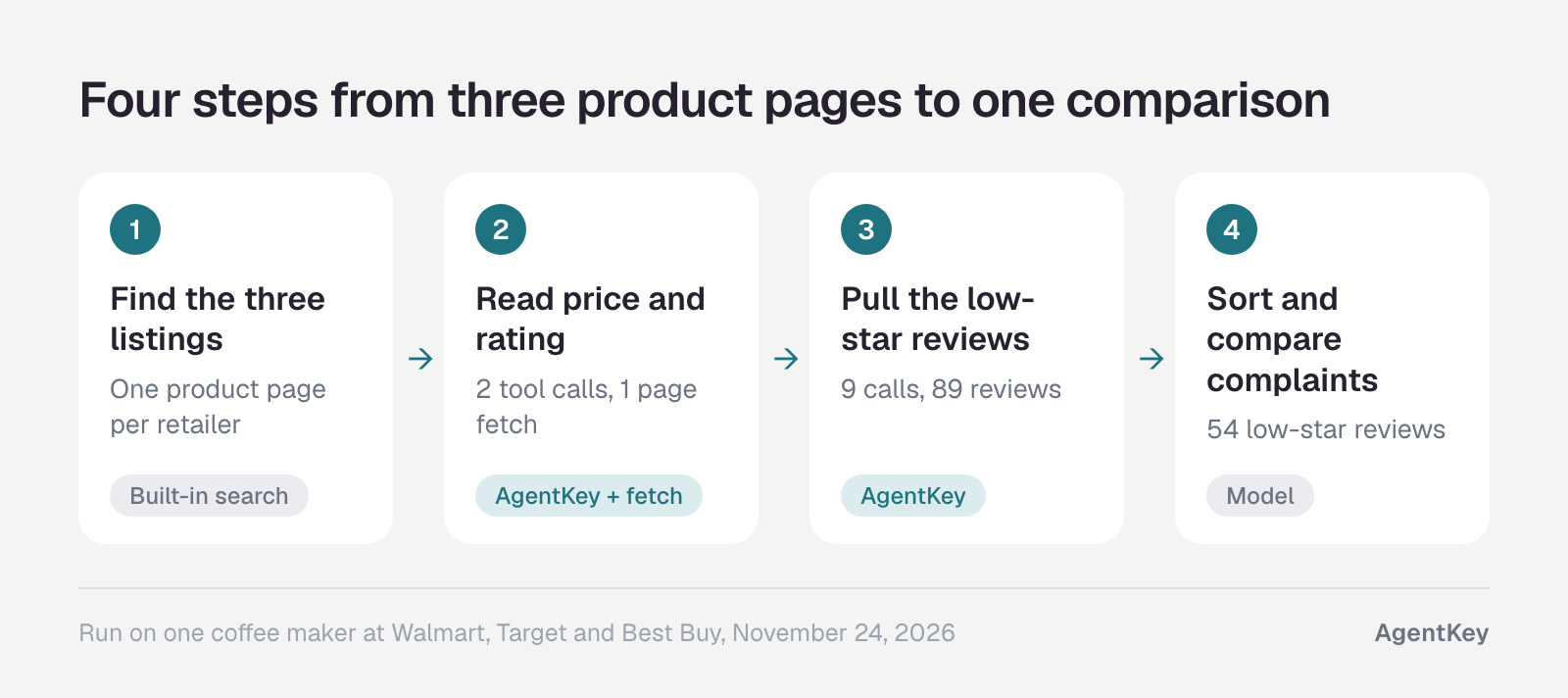
Connect AgentKey once, then run four steps: find the listings, read price and rating, pull the low-star reviews, and sort the complaints.
Before you start
Install AgentKey with the one-line installer, which adds it to the agents on your machine and opens a browser tab to sign in. A new account starts on the Free plan with no card.
curl -fsSL https://agentkey.app/install.sh | bashOther install methods are in the installation guide. The Walmart for Claude Code page shows what the connection gives you.
Step 1. Find the product page at each retailer
This step does not need AgentKey. One built-in web search limited to the three retailer domains returned the product page at Walmart and Target and the reviews page at Best Buy, whose address carries the same product number.
Check that the listings are the same item before you compare them. Walmart and Best Buy returned the same UPC in Step 2. Target sells the product as one listing with three colors, and the Target tool returned no UPC; a second run read the matching UPC from Target's page.
Step 2. Read price and rating at each retailer
Your agent calls Walmart Product and Best Buy Product, and reads Target's page with its own fetch. That is two calls for 0.4 credits.
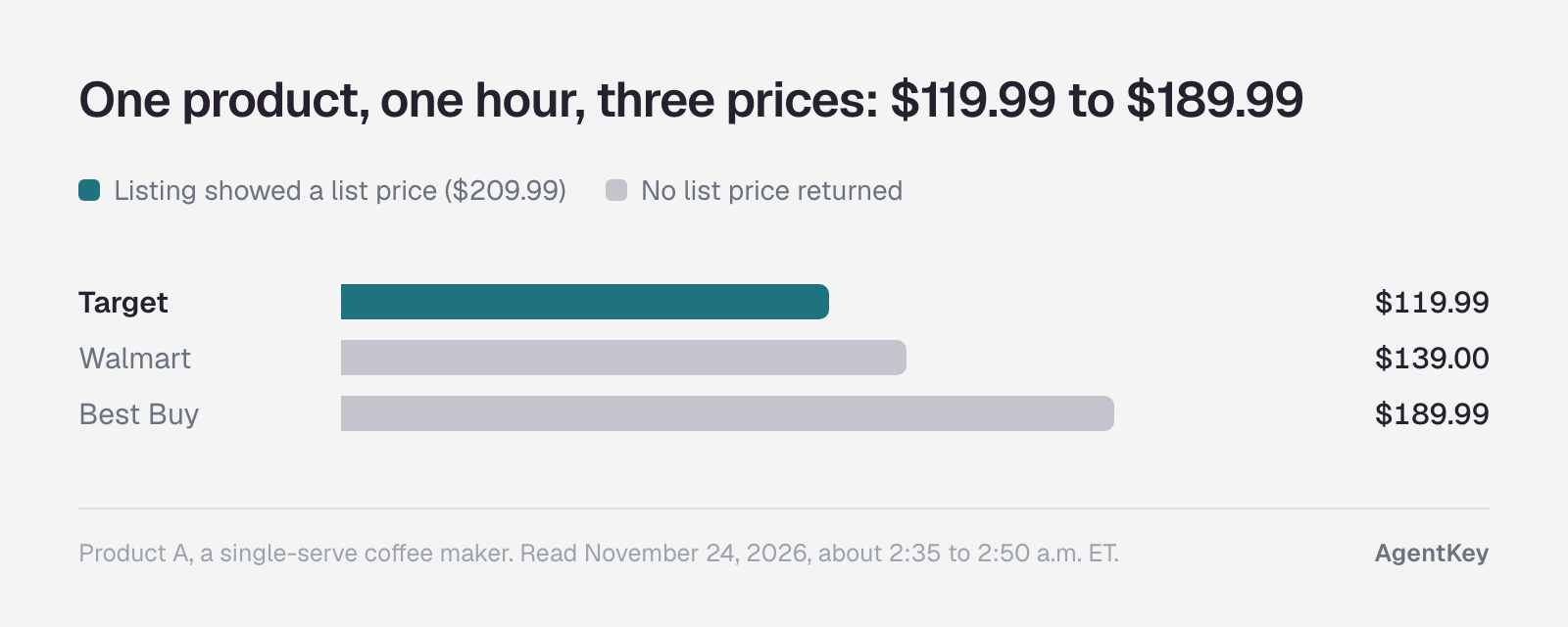
On November 24, 2026, between about 2:35 and 2:50 a.m. Eastern, the same coffee maker was $119.99 at Target, $139.00 at Walmart and $189.99 at Best Buy. Only Target showed a list price, $209.99, with a "$90 off" label.
Ratings were close: 4.5 from 19,422 reviews at Walmart, 4.4 from 11,692 ratings at Target and 4.7 from 4,507 reviews at Best Buy. Walmart and Target showed the item in stock, and Walmart and Best Buy each named the retailer as the seller.
These are promotional prices from Black Friday week. Read them as one timed snapshot.
Step 3. Pull the low-star reviews
Ask each reviews tool for its lowest-rated reviews, then look at what came back before you count. Nine pages cost 1.8 credits.
Best Buy did what we asked: 20 one-star reviews, newest first, from April 2023 to October 2026. Walmart returned 20 one-star reviews in no date order, from October 2020 to April 2026, and one review appeared on both pages, which leaves 19.
Target ignored the sort, so we read its five newest pages and kept the low ratings. That gave 15 low-star reviews out of 50, dated March to November 2026.
A second agent ran the same prompt ten minutes later. Its prices, its Best Buy dates and its Target counts matched ours, but Walmart gave it a different set: 20 one-star reviews with no repeat, reaching back to October 2019.
Step 4. Sort the complaints and compare
This step is the model's work. Each low-star review gets one theme, and the themes are the same for every retailer.
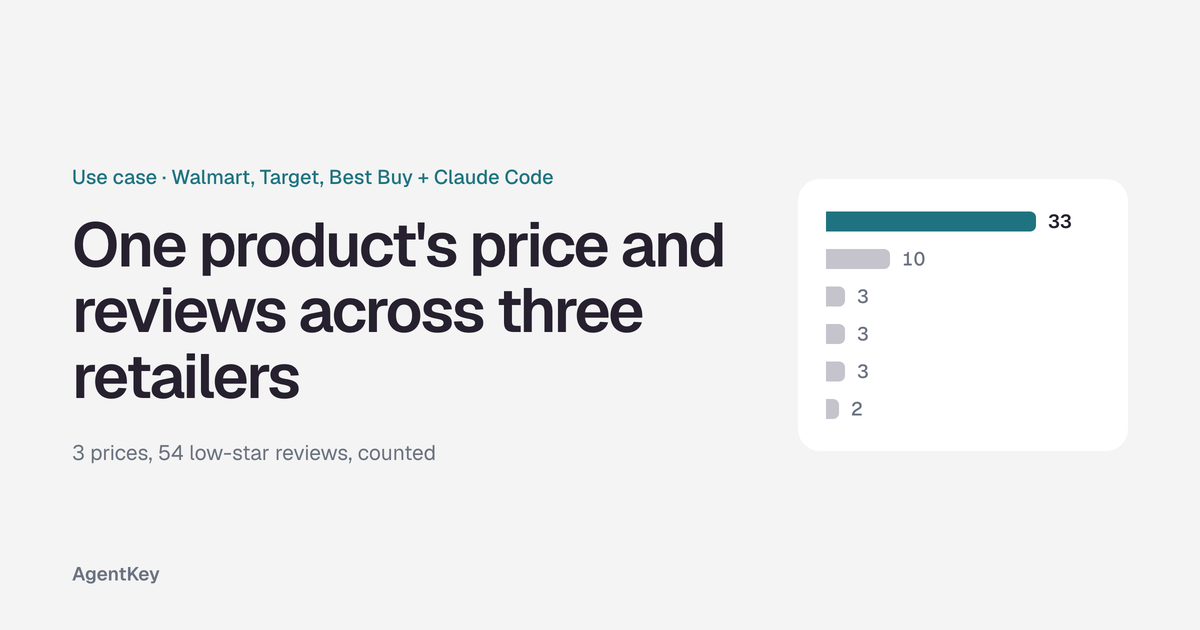
Stopped working or shuts off led at all three: 11 of 19 at Walmart, 12 of 20 at Best Buy and 10 of 15 at Target. That is 33 of the 54 low-star reviews.
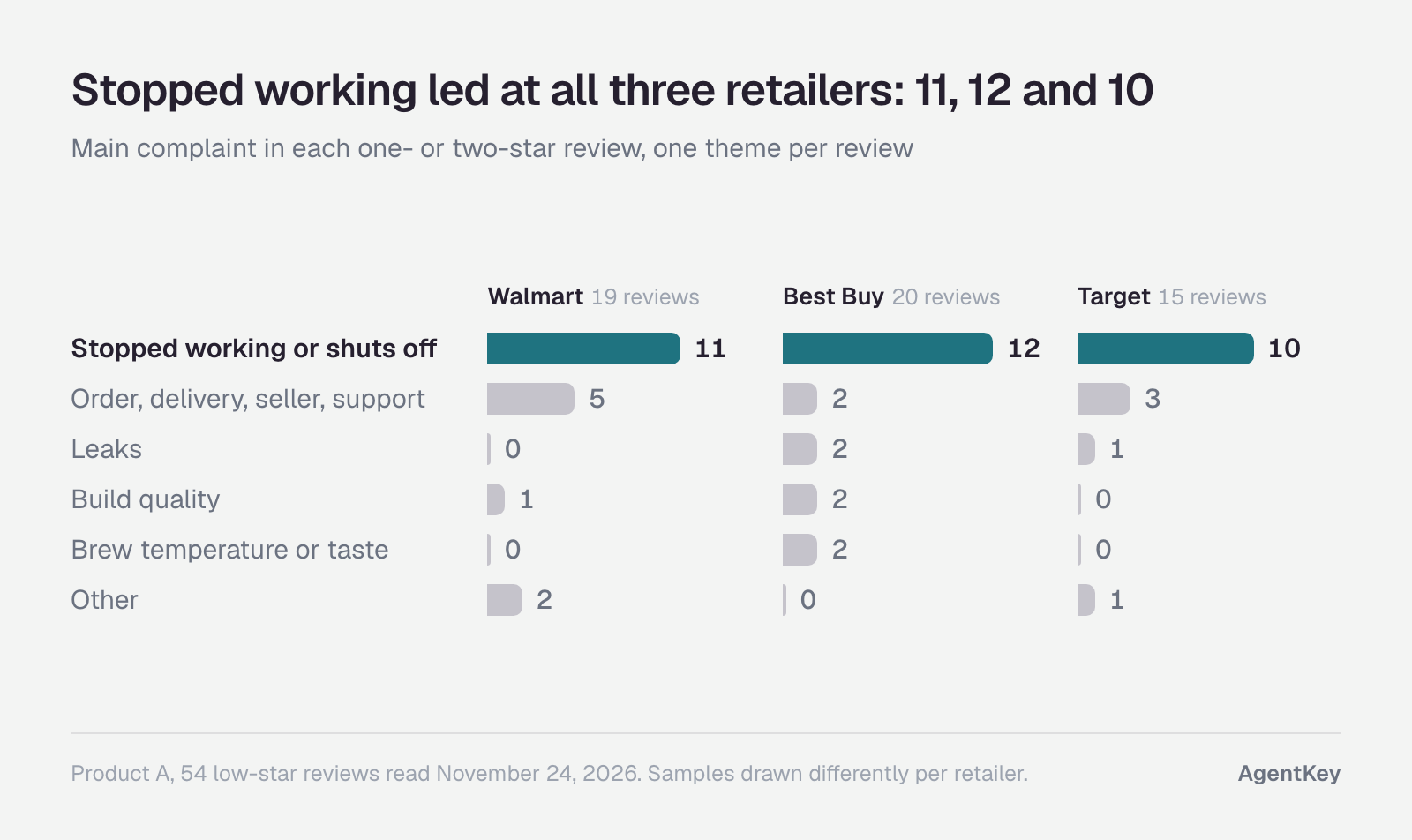
The second theme is about the retailer, not the product: order, delivery, seller or support, with 5, 2 and 3 reviews. At Walmart these were orders that never arrived, a wrong item and a double charge. At Target they were a damaged delivery, a late one and a unit that looked like a resold return; at Best Buy, a refused price match and unreachable support.
The other themes, in the order Walmart, Best Buy, Target: leaks 0, 2, 1; build quality 1, 2, 0; brew temperature or taste 0, 2, 0; other 2, 0, 1. Our reading is that the three retailers tell the same product story, and a few reviews at each belong with the retailer's operations team.
How do you check the results?
Check how each sample was drawn first, then recount a slice by hand.
- Compare the samples. Walmart's and Best Buy's are the lowest-rated reviews over several years. Target's are the low ratings among its 50 newest. They are not like for like.
- Test a sort on one call. A lowest-rated page should hold only low ratings. Target's first page held seven reviews rated 5 stars.
- Remove repeats. One Walmart review came back on both pages.
- Look at the star distribution. Target's showed 1,030 of 10,101 ratings at one or two stars, about 10%. Best Buy's showed 115 of 4,507, about 3%. Walmart's tool returned none.
- Expect counts to disagree. For Target, the page said 11,692 ratings and the reviews tool said 6,286 reviews.
- Ask where a review was written. One Walmart reviewer said the manufacturer had asked for the review, so some reviews may come from the brand's own site. That is our inference.
- Read flags with care. All 20 Best Buy reviews carried an incentivized flag that the tool does not define.
- Run it twice. The second agent's Walmart sample differed from ours, and it put 12 of 20 under stopped working against our 11 of 19. Its Best Buy and Target counts for that theme, 12 and 10, matched ours.
- Recount one theme. Open ten reviews under stopped working; if more than two belong elsewhere, tighten the rule.
- Treat reviews as claims. Fifteen to twenty reviews per retailer support the top theme and little else.
When should you use something else?
Use a different route when you need less than this, or much more.
If you only sell through Target, or only need today's Target price and newest reviews, your agent's built-in fetch was enough in our test. It read the price that the Target Product tool left empty.
If you need every retailer, every day, with alerts and history, a retail price-monitoring service is built for that. We did not test scheduled runs with AgentKey, and one reading in a promotion week says nothing about last week.
If you need a full review export, use the retailer's or brand's own review platform. Walking Target's pages ten reviews at a time for all its low ratings would have cost far more than this run.
This is the AgentKey blog, and AgentKey provides the tools described here. They return listings and reviews. They do not match products, sort complaints or explain a price gap.
Which tool should you use for each job?
Pick the call from the question. Prices were verified on November 24, 2026, and are what our run was charged.
- Find the product pages: built-in web search. Free.
- Read Walmart's or Best Buy's price and rating: Walmart Product or Best Buy Product. 0.2 credits each.
- Read Target's price and rating: built-in page fetch. Free in our test.
- Lowest-rated reviews at Walmart or Best Buy: Walmart Reviews or Best Buy Reviews, sorted rating_low. 0.2 credits per page of 10.
- Recent low ratings at Target: Target Reviews, newest first, filtered by rating yourself. 0.2 credits per page of 10.
- Check a price before spending: tool discovery. Free.
Conclusion
You now have a timed price row for each retailer and a count of what low-star reviewers say at each. In our run the product story matched across all three, and the differences were about delivery and service. Run it on your own product, and reread the reviews behind any number before it reaches a retailer meeting.
Connect Walmart to your agent through AgentKey →
FAQ
Can Claude Code read Walmart, Target and Best Buy without AgentKey?
One of the three, in our test on November 24, 2026. Target's product page was readable, Walmart returned a robot check, and Best Buy's pages timed out. Other agents may have different built-in access.
Do I need to write code?
No. You install AgentKey with one command and then ask your agent in plain language. The prompt above includes the one jq expression we used to trim the review pages.
How much does one comparison cost?
Our run was charged 2.2 credits for the 11 calls in the steps: two listings and nine pages of reviews. A second run of the prompt was charged the same. The tools are metered, so the prompt tells your agent to stop if a call is charged more than 0.4.
How many reviews can I pull?
Ten per call. The tool descriptions say Walmart serves up to 100 pages and Best Buy up to 1,000, and each page is billed as one call. We read two pages each at Walmart and Best Buy and five at Target.
Can I get only the low-star reviews?
At Walmart and Best Buy, yes: the lowest-rated sort returned only one-star reviews in our run. At Target the same setting was ignored, so we read the newest pages and kept the low ratings.
Does AgentKey sort the complaints?
No. AgentKey returns the listings and the reviews. Your agent's model assigns the themes and counts them, which is why the prompt asks for examples you can check.
Is there a free way to try it?
A new account starts on the Free plan, which includes complimentary credits and needs no card. Finding tools and reading their prices does not use credits.